Friday, May 04, 2007

Funny thing about "The Short Game Bible"


I've been a follower of ...The Bible for a while--Dave Pelz's "Short Game Bible" that is. In it, he's got all kinds of advice on how to be an effective shot maker inside 100 yards, which is where all rounds are made or broken. The book is chalked full of stuff like this:

That is to say, proper short game technique. And it works, but if, and only if, you have a correct golf swing. I did not have a proper golf swing for many years, and because of this, there were certain parts of his instructions that always befuddled me; namely, how to hit a 7:30 pitch. Let me explain. Pelz divides the swing into four levels of power, and he uses the face of a clock to illustrate these positions--backswings to 7:30, 9:00, 10:30, and full should enable you to cover any distance of shot. However, if you don't have a well-founded swing. the lower-power swings, 9 and 7:30, will be particularly vexing. In his book, Pelz admits that he's not teaching the golf swing, per se; he's teaching how to use the swing you've got (again, assuming yours is proper) to get more out of it. So, if Pelz's instruction, or any short game guru's, for that matter, has given you fits, try and straighten-out your full swing.

Thursday, April 26, 2007

Ben Hogan + living room video cam + too much time = better swing


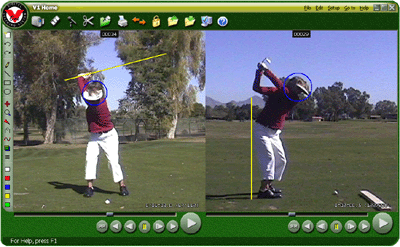
I finally read Ben Hogan's famed "Five Lessons." It gives you the model on which you should base your own swing. The only thing missing is (besides drawings of his swing from behind, and not just face-on) a way to compare your swings to Mr. Hogan's model. Enter V1 Video Analysis Software . It's the kind of software that lets you do this:


You can look at all your angles, see how much you move during the swing, determine if your pronating or supinating, and most importantly, compare your swing to one of the swings of professional golfers from their video library--all for free (and for a mere $40, you can upgrade to a version that lets you play your swing alongside a pro's. But if you're just starting out, I'd say you can keep your money -- if you get really serious about improvement, $40 is not much to spend.) Even on my old laptop (850 MHz Pentium III) it ran perfectly smoothly. To see yourself compared to a pro is an epiphany. A few things I discovered were: swings recorded in the living room were equally valuable to swings recorded at the range; feel is, as the cliche goes, not real, i.e., what you think you're doing is not what you're actually doing.

Wednesday, April 18, 2007

Choose your weapons wisely...

I would imagine the golf club industry is like any other, where those with the lion's share or the market do their best to limit the success of small upstarts who, in any miniscule way, threaten their dominance. For instance, Nike, Titleist, Taylor Made and Callaway would probably like for nothing better than lesser-known club companies to die or, at least, sell themselves to them. That's why companies like SMT Golf intrigue me. They appear to make drivers (and it looks like they're tangentializing into irons and fairway woods, too) that seem to have the edge on the designs of bigger companies. I'm no engineer and have no objective means to judge the claims SMT makes, but the fact that a pro (330--seriously?) played their gear without remuneration--or at least, considerably less than a big company could have offered--suggests that either Schwarmkrug is possibly sitting in a motel somewhere crying into his beer, "I'm so stupid! Why didn't I take [Ping's, Titleist's, TaylorMade's] money? Stupid, stupid, stupid!" Or, alternatively, believes in SMT. This also brings to mind another small club company in souther California, KZ Golf. (Disclaimer: I interviewed with them in sales, but decided against it when I came to understand than I would a lousy salesman.) They only sell clubs that are custom fitted to the prospective buyer, which is, after all, what most golfers should be doing. Not only does the fitting process match club to a golfer's physique, but the tester can also point out any egregious swing errors the fittee may be exhibiting. If you see a set of KZG clubs on ebay, don't waste your time buying them because they were fitted to someone else who is not you. Speaking of fitting, Maxout Golf, also here in southern California, does custom fitting, but they don't sell proprietary clubs. Like KZ Golf, they'll fit you, point out your swing flaws, and most likely give you enough improvement that you'll be grateful for the rest of your life.

All these companies--SMT, KZ Golf, and Maxout--offer services that the big golf manufacturers would be happier if you didn't know about, and that if you use them, you'll be better off than buying off the rack.

Wednesday, February 14, 2007

I forgot to not try to not remember


A funny thing happened to me on the way to a golf shot--I forgot my SWING THOUGHTS! Like greased pigs, they slipped through my fingers. Without them, I I felt naked, exposed, and vulnerable (dangling, if you know what I mean) as I stood over my ball and failed to latch onto any of the litany of swing thoughts whizzing through my mind like children swirling by on a teacup ride, "Kick knee in, keep arms close, hands low, rotate torso..." I couldn't focus on any of them, so decided to screw it and swing away. Hit an 8 iron to 5 feet. A few shots later, went through the same process (or lack of) on a wedge--chunked it half as far as I should have. Bloody confusing business. However, I think I'm going to stick with this. It's much easier to let the annoying, cloying, desperate swing thoughts go somewhere else while I play golf.

Saturday, September 30, 2006

Golf is improv

Many golfers are misled by watching the pros, who tend to make golf look robotically simple. But it isn't. Each shot is an event unto itself, so golf is actually complete improvisation. Not shot is set in stone, but must be thought out and felt on a moment-to-moment basis. Instead of hoping your round will conform to anything approaching a pro's round, it instead is a shot-by-shot experience, where each shot is a completely original and not-to-be-repeated event.


"Who does this guy think he is?"
"I don't know Danny, but I do know this: no one has ever played better than me in a button down shirt."

Monday, August 21, 2006

Go, baby, go!

I like underdogs. In any sport, when underdogs win, it's almost always more exciting, more entertaining. I used to feel that way about Tiger Woods. If anyone could mount a comeback with Woods in the lead, I was backing the little man every time.

But not anymore.

Woods' wins over the last two majors have completely turned me around. Not only do I want to see him win, I want to see him win everything. We golf watchers are in the presence of greatness, and I would like to see that greatness compound itself beyond not only my expectations, but even my imagination.

If there was any doubt that he's the best golfer ever, he put those doubts to rest. The downside to this is that now, golf writers will feel even more compelled to construct rivalries between Woods and other golfers, but those rivalries are as contrived as the President's Cup. Woods has no peer. In a couple of years, Woods may reconstruct his swing, and for a season or two, the vacuum created by his absence will bring a few players to the fore, but inevitably, Woods will return and take back the mantle of Best Player Ever.

Friday, July 21, 2006

Hair (and I ain't talking Rado, Ragni and MacDermot)


I've got no problem with daring hair styling choices. I've even toyed with the idea of mixing up my standard hair look a few times myself. But if I could give a word of advice to Euro golfers: The "Highlighting Era" has long sinced passed. The only people still highlighting over in the U.S. (specifically Glendale, CA) are young Armenian women, who, too, apparently didn't get the message that blonde highlights now officially look ridiculous (I'm pretty sure the federal government sent out a mass mailing to that effect.) Euro golfers--if you want to be a rebel, try a hair style that you think up yourself, or at least, have only seen on the newest punk bands. I understand that pro golfers have to walk to thin line between appeasing their ultra-conservative corporate money men, and, on the other hand, trying to avoid in oneself the feeling that you're not just another guy whose main contribution to society is chasing a hard white ball. It's tough, I admit. But for the love of God, dousing your scalp with a bottle of hydrogen peroxide is no way to make an existential statement. How about an arm-band tattoo--barbed wire, perhaps?


Next week: Why you shouldn't waste your time reading Über-hacks Cameron Morfit and Ron Sirak.

Friday, July 14, 2006

Stop the insanity!


There is a certain kind of golf madness. A madness that is born of equipment. Much equipment. Choices of equipment.

For instance--which irons do you want? Game-improvement, or ultra-game-improvement? Semi-stiff, high-torque, or low kick point with high torque? Do you need a 350cc driver, 400cc or 460cc? How about hybrids vs. fairway woods?

Yes, this is insanity, and, what's worse, it can infect other aspects of your life. For instance, electric guitars offer as much choice wackiness at golf, if not more. Of late, my golf setup has been quite settled, but I've taken up the guitar, and have worn myself down to the nub looking at used guitars. A pox on eBay!

Monday, June 19, 2006

Tiger, come back.

Let me qualify the title of this post. I'm not a huge Tiger fan, simply because he doesn't embrace his role as the #1 golfer in the world with much eagerness--no signings, no bumps, nothing. He could use a lot less prima dona and more Everyman. But that aside, it was amusing to watch the U.S. Open unfold without Tiger's presence--we could subtitle the '06 Open the "Implosion" Open. Afterall, how many pros had a chance to win the event with nothing more than a par at the last? Furyk, Monty, Figjam Mickelson, and Harrington all had a chance to win--on 18, no less--but fluffed it out. The sad thing is that the back 9 had potential fto produce drama we hadn't seen in thirty years. Monty could have landed his elusive major, or Furyk could have gone on to claim his spot among golf's semi-greats. Figjam Mickelson could have laid claim to a spot as a genuine Tiger threat, having won three of four of the last majors. Instead, we were faced with a bunch of guys shaking their heads after missing shots which could have brought them the Open. Oh well, majors are meant to be won or lost on fantastic plays, and the '06 Open was no different--just so happens the plays were real stinkers.

Monday, June 12, 2006

Golf's Big Five bores or Come on, Golfers -- Act Like You WANT it!

It may gratify some to watch the perennial favorites win, but I'd rather watch the smaller, more significant dramas unfold. Take last weekend's Barclay Classic. An early leader was Billy Andrade, a pro golfer who has fallen on relatively hard times (I say "relatively" because with his sponsorships and earnings, he's still doing financially better than 97 percent of Americans--$11 million career earnings since '87 (by comparison, I've made $600,000 in the same period.)) Azinger commented that Andrade is no longer exempt, and needs to get inside the top 125 in earnings to secure his card for next year. A win would have gone quite a ways toward that end, but he didn't win. He played good, but not great, and came in fifth. One more top ten and he'll probably be okay for next year. But isn't it more fun to watch a guy like Andrade play for his life and/or career than watch Veej stoically win another check for his retirement fund? I could have even rooted for Adam Scott, who is also quite stoic, if he had shown in some demonstrable way that he really wanted to win--a twitch, hyperventilation, ANYTHING. Which brings me back to the Big five Bores. (Note: These guys may not currently be in the top five, but they are more often than not in the top five, which is why I'll spend an inordinate amount of time commenting on them.) Woods can be fun to watch--when he isn't acting like a robot, but Mickelson, Veej, Els and Goosen are sleep-inducingly boring.

Thursday, June 01, 2006

Living without a net

I was watching the Golf Channel the other night and their resident psychologist took a question from a viewer. The viewer wanted to know if, since he had lowered his handicap from 18 to 8 in a year, he was justified in wanting to turn pro. My first instinct was to wonder, "Are you NUTS? At least get to scratch and play some competitive golf and see if you like it." The psychologist decided he had no right to tell anyone what to do with their life--which is true--but for the would-be pro to be cautious.
I then went on to consider my own life, and the risks I've taken on as a would-be pro writer in Los Angeles. I guess I could also apply the "Are you NUTS" comment to my own life. I'm probably about an 8 handicap writer--better than 99 percent of the public, but still with lower handicap writers ahead of me, and a few more hard-knock lessons to learn. I think Ray Bradbury said it best:
If we listened to our intellect, we'd never have a love affair. We'd never have a friendship. We'd never go into business, because we'd be cynical. Well, that's nonsense. You've got to jump off cliffs all the time and build your wings on the way down.

I guess that means if you're an 8 handicap golfer or writer, it's time to jump.


Thursday, May 25, 2006

Flowers for Algernon: The Golf Edition


My golf game can be defined as consisting largely of the vast valleys between Algernonaic heights of golf enlightenment. You know what I mean--those rare times when your swing seems to take over on its own and hitting the ball perfectly and with great command seems like the easiest thing you've ever performed. You can't WAIT to hit the next shot because it's so damned easy.
But then, inevitably, the magic evaporates. You're left holding the husk of understanding, trying to pump life back into that husk, trying to get back the magic, but it's gone.
I've learned that you have to take what understanding you can from those inspired moments, and then forget them. Magic will take care of itself--since it comes and goes at its own whim--and there's no point in trying to bring it back. If you can remember what you were doing in your swing that made it work better than what you had been doing before, then study it. But don't cry for the lost magic--it will return again at a time of its choosing. Be happy when it does, but also be happy when you're grinding away in the valleys, trying to figure out how your swing works. Your handicap won't go down by waiting for magic, but it will while you dig that swing out of the valley's dirt.

Monday, May 22, 2006

To forgive or not to forgive

There have been times in my golf life upon which I have looked back and wondered, "What in happy horseshit was I thinking?!" Case-in-point, my dabbling in the world of forged blades.
Blades are not impossible to hit. If you're swinging well, you can play just as well with them as with any other club. The problem was when I was swinging well, it was usually on the range. And range performance doesn't translate to the course. Actual golf, when played for score, is a much more random and unruly beast than swinging on the range. I made the switch back to uber-forgiving clubs (Ping Zings) a couple of years back and don't regret it a bit. I've recently been looking at an even more forgiving set, '94 Callaway Big Berthas.
I'm a solid 12 handicap, but I feel the more forgiving club I can play, the better. Actually, when talking about forgiveness, we're only really talking about long and mid-irons. Short irons, be they cavity back or blade, play about the same, because in both types, the club's face is so much closer to horizontal that the center of gravity ends up being in about the same spot.
I had the rare gift of taking a novice golfer through the paces of buying a complete set of used clubs at Roger Dunn. When I saw a used set of '94 Berthas, I told my friend (as I wiped the drool from my face) "Buy those." He hit them, I hit them, and they really are super forgiving, even more so than my Pings. Of course, they were regular flex, so the soft tip wasn't as precise as a stiffer shaft, but all-in-all, I was very happy that my friend lucked out and found those clubs. He tried putters, woods, wedges and bought a full set of everything. When we got to putters, we went straight to the "used" bin, and found some incredible deals. We both thought the Baby Ben Bettinardi putter (marked down from $200 to $50!) was quite the deal. He agreed and even paid me for my troubles with a Baby Ben Bettinardi putter. As for the '94 Callaways, they can be had for a song on eBay, so as soon as I get a job, I'm picking up a set, ooky stares from my wife be damned!

Thursday, May 18, 2006

Expectations, the scourge of western civilization

Okay, the G.I.R. thingy didn't work out (or rather, my ability to hit more than three G.I.R.s didn't work out). I only hit three, but kept it under 90, but only by two measly strokes. Granted, I was playing for the first time at De Bell in Burbank, so I was scuttled somewhat by lack of local knowledge. I'm going to play there again next weekend, so I won't have my lack of local knowledge to blame.
Here's a question I'd like you readers to answer: when playing with different clubs, say, a buddy's borrowed set while on a trip, do you usually play better or worse? I recently played with a buddies Cobra SS irons and I hit them pretty good. They had regular shafts, where my Ping Zings have stiff, which begs a question: are my Ping shafts too stiff for my swing? I've never been professionally fitted, and at around $250 to have it done, it isn't going to happen anytime soon (I suppose when my ship comes in, I'll get fit and buy a Sky Caddie on the same day. Of course, after buying my wife an exquisite piece of jewelry. Or at least, I'll let her think I bought her the jewelry first.)
So from a shaft fitting perspective, it's equally likely that I'm playing overly stiff shafts. Oy, I thought I'd put all this club buying shit behind me. I've got much too many things to obsess about--spec scripts I need to write, job to find, self to convince myself doesn't exist, which Fender or Gibson knock-off electric guitar to buy (I'm leaning heavily towards an Agile Les Paul knock off, they've gotten great reviews on Harmony Central. Plus, there's no way I'm going to Guitar Center or Sam Ash to play one. Firstly, they don't carry Agiles, and secondly, I CANNOT STAND when the guitar salesguys hover over you as you play. I feel naked, and since my playing is at the novice level, it's just too frustrating to play in front of them. I know, I know, you're saying, "Get over yourself little man." But it's just human nature to feel castrated in that situation, and since I spend most of my mental effort trying not to be castrated by the actual competitive world, I don't feel like going to the guitar shop and coming so close to castration when the guitar is supposed to be fun.)
So, back to shafts, I think my Ping shafts may be too stiff. So you know what I did? I went and swung my wife's clubs, which have Senior flex shafts (known as "A" flex: interesting sidetrack. Back in the day, "A" flex stood for amateur, and no one in the golf industry has felt like changing it.) The swings felt great. Fast, easy, little effort. So, tomorrow, I'm going to do a head-to-head comparison at the ole' range. If the Gramps shafts win out, it could be curtains for the Pings, though I am LOATHE to part with them. I'm attached, you know? They've suffered right along with me, but then again, they may have been responsible for a lot of that suffering. So DAMN them to HELL.
Which brings me to another subject and another question for you, the reader. Why is it that people become attached to things? Like the shirt that Uncle Bob gave you during that summer on the Cape? The recipe Mom gave you before she died? A Christmas ornament Grams and you painted when you were five? What does all this stuff MEAN? Mom is dead, and making that recipe in her honor isn't going to change that? Right? This is a tough question I've struggled with ever since my Mom died 20 years ago, but it applies to any kind of regret or sentimentality. After all, the recipe, or the shirt, or the ornament are just a symbol for something in us that we can't let go of, but was is it? I suppose if I could answer that question, I'd probably be on the road to... well, I'd be on the road, which is a something.

Ciao.

Friday, May 05, 2006

KZ Golf and what to buy

I went on a job interview with KZ Golf, a custom pro-line manufacturer. I didn't take the job because me and "sales" are like Superman and kryptonite--just doesn't mix. But they were a really cool bunch who believe every word on their website. You see, the Big 5--Nike, Titleist, Callaway, Cobra and Wilson--rely on advertising to get you to buy their products. Whether or not you shoot better scores is irrelevant, because, they know if you don't play well, you'll blame yourself, not their clubs. Enter KZG. They only sell their clubs to retailers who can custom fit you to the gear. I've never been fitted, so I can't say if fitting really is as important as fitters claim. I did have a Ping fitting, and they recommeded I play upright clubs (green dot), but the one time I played a buddy's green dot set, I hit just as you would expect to if they were too upright--slices all the way (and I NEVER slice.) Still, I'm DYING to go through the fitting process, but it'll have to wait until I, at least, have a job. And if you think you might want to buy KZG stuff off eBay, whether used or new, don't bother--if you can't get the clubs fit to you, there's really no point in buying them (which I learned at the job interview.)

I may have mentioned this before, but aside from a fitting, the only other golf item I really, really want is the Sky Caddie. Trying to guess yardages is a pain-in-the-ass, and I would love to see how much better I play if I had accurate measurments while I played. Sadly, new Sky Caddies are $350, and you have to buy a yearly subscription (anywhere from $20 to $60.) Now this is an item, unlike the KZG clubs, which I will wholeheartedly buy on eBay. They usually go for around $300, but hey, fifty bucks is fifty bucks.

I'm playing tomorrow at De Bell in Burbank. It's a "sporting" executive, which means there are par 5s, but instead of relying on distance to pose the challenge to par, the course uses doglegs. For instance, I think there's a 450 yard par 5, which, under normal circumstances, would a fairly easy hole. But, De Bell has thrown-in a right turn just short of the drive's landing area, so you'd best be accurate. But the radical bit of info I recently learned is this--QUIZ: there is a strong correlation between which of the following: a) driving distance, b)driving accuracy, c) putting, d) sand saves, or e) greens-in-regulation? The answer is "e", G.I.R. More than any other factor, how many greens you hit has the most significant correlation to score. And this holds true for pros as well. To break 90, you have to hit at least 3 G.I.R.s; 80, you have to hit at least 8 G.I.R.s; 70, you have to hit at least 13 G.I.R.s Cool, huh? Here's the article from Golf Digest's website:

By Lucius Riccio, Ph.D.
Golf Digest
May 2006


Of all the statistics in the game, only two really matter when it comes to determining score: greens hit in regulation (example: you hit a par-4 green in two) and putts. Breaking 80 usually goes with reaching certain benchmarks in these areas. To help you get there, Shelby Futch, who heads the Golf Digest Schools, has provided some quick tips (below). My job is to show you the numbers.

Most golfers think putting is the biggest factor in scoring, but greens in regulation (GIRs) are much more important. So important, you almost don't need to look at anything else to predict your score. The most useful score-analysis tool I've developed, called "Riccio's Rule" and first published in Golf Digest in 1987, predicts score based on GIRs: Score = 95 – 2 x GIRs. The chart below, based on this rule, shows how GIRs relate to score:


The above is a chart that didn't load, but here's the info in it (G.I.R.=average score):
1=93, 2=91, 3=89, 4=87, 5=85, 6=83, 7=81, 8=79, 9=77, 10=75, 11=73, 12=71, 13=69.

Here's a quick way to remember the effect of GIRs on your score: "Three greens break 90, eight greens break 80, and 13 greens break 70." That prediction is fairly accurate for any single round, and within one stroke about 90 percent of the time when you take the average of four or more rounds.

So that's our first part: To consistently break 80, you should average eight or more GIRs. Take a few recent scorecards, or record your next few rounds, and average your scores, then average your GIRs. Compare your results to the chart at left. I bet you're right at, or very close to, where the chart says you should be. But if you score better than your GIRs would predict--say, you hit four greens but average 83--you probably have an extraordinary short game. You need to focus on hitting more greens. If you score worse than your GIRs would predict--say, you hit seven greens but average 85--then your putting is weak, or you tend to have blowup holes, which throw off any system for predicting score.

So, it would seem that paying attention to G.I.R.s is more important than avoiding 3-putts. I'll be putting this insight to the test tomorrow and will let you know how it worked out.

Here's a depressing thought: I now know of three people who went from rank beginner to scratch golfer in one year: Greg Norman, Earl Woods, and Mike, the fitter at KZG.

Monday, April 24, 2006

Playing versus practice

I had an enlightening experience the other day. I went to my favorite practice course (Scholl Canyon in Glendale, CA) with my usual intention to play 9 holes and try all kinds of different shots on the course, i.e., practice. I wasn't going to worry about my score, but then I decided to chuck the idea of practice and really try to get a score. Now, I'm not here to say to say I shot the lights out; no, I did what I usually do--hit it loose on the front, tighten it up on the back. But what did happen was that I was able to concentrate on each shot and not worry about my score or technique or any of the little niggling things that distract and keep me from playing well. I also experienced that strange yet common golf experience of remembering the correct techniques for certain shots--you know, you figure out a technique and say to yourself, "Wait a minute, I taught myself this last summer. Man, get with the program!" I think most golfers remain "average" because they can't improve their skills--or even maintain--due to lack of practice time. Ever notice how really good golfers always seem to have come from country-club- member parents? The club provided the young golfer the hours-upon-hours of practice time needed to learn and re-learn skills--a process we average Joes string out over decades.

One way to optimize practice is to make sure you're relaxed while you're doing it. Unexpectedly, I learned something from my ongoing guitar learning experience that applies to golf. I found a guitar teacher on the web whose system of practice applies perfectly to golf. Check out this here. I'm sure this guy's lessons (or girl--is "Jaime" male of female?) can be applied to everything from guitar to golf to painting to yoga.

[Note: there's a link the guitar man's site to the left]

Friday, February 17, 2006

Survey results and this world of ours

Just as I suspected, my loyal readers are conscientious, rational, are neither religious nor Bush dogmatists, and feel that good golf comes from practice and confidence. And here's where my heart really goes out: you all feel you could be playing much better; in fact, you feel your golfing potential is largely unfulfilled--if we were fulfilled, we probably wouldn't be golfers.

You just got to stick with it. Golf, guitar, writing, and scrimshaw all require persistence for mastery. But jeez, it does sometimes just piss you off when we don't "get it." Practice is supposed to make us better, and when it doesn't, you can feel like the chucking the whole thing. Maybe that's a sign it's time for a break. My shoulder injury worked out great for my game. I'm hitting it like never before. I'm heading the course this afternoon, and when I get back, I shall post my new personal best score (I know it's going to happen, I can just feel it.) So, see you in a few hours.

Ciao.

Tuesday, January 10, 2006

This week's SURVEY

Well, I did it. Yep, my rotator cuff is cheese, so until it's back to 100% health, I've been benched. No more golf for a few months. Instead, I'll be getting into shape, doing all kinds of exercises I should have done a long time ago. For those of you with a similar injury, don't let your doctor talk you too quickly into surgery unless you are in extremely bad shape; I'm talking excruciating pain. Stretching, strengthening, and rest from the offending sport can restore most rotator cuffs to full health. Surgery causes lots of nasty scar tissue which is really tough to stretch, so only use surgery as a last resort. While I rehab, I'll still be talking about the insanity that is golf, but in the meantime, how about a little survey? I'd like to know what my visitors think, so take a minute and follow the link, follow the link, follow the yellow brick link and fill it out (there's a link back to my blog if you so choose to return.) I'll post the results in a few weeks.

Thursday, December 29, 2005

Okay, golf, you win. Just stop punching me in the nads.


Woods and his caddy having
trouble connecting their High-5. Confidence issues?

I don't know how much longer I can take this. Went out and played a round with my brother, and I was hitting the same stupid hooks that I never, ever hit on the range. What the hell is that about? How can I degrade from my great range swing to an almost unusable swing on the course? Well, let's see. Of late, I've had a hard time of it, what with trying to write some spec screenwriting material (which isn't going so well), and all the year-end self-evaluation, I'd say my self-image is not at peak form. So I guess it's not surprising that I'd go out and not hit the most confident shots--I'm probably a little too much in my head. But jeez, not "The Hook." I thought I'd seen the last of the shot which is this blog's namesake. It's kind of like getting up to sing before an audience, opening your mouth, and only French comes out. You stop, regroup, say to yourself, "Sing in ENGLISH! ENGLISH! ENGLISH!" Take a deep breath, open your mouth, and out comes French again. Oy vey, to be a man on the golf course is to suffer. To top it off, every joint associated with the golf swing--shoulder, wrists, neck--is perpetually sore, so I may have seen my last golf for awhile if my doctor tells me to let my ligaments and tendons take a rest.

Maybe the point of a bad swing is to just stop caring? Just let it do its thing, I'll do mine, and go with the flow. Of course, practice is required, but once on the course, maybe you're supposed to make due with what you got, and leave the beautiful shots to the land of dreams from whence they came? I know that sounds a little high-fallutin', but what other options do I--or any of us--actually have? Sure, it would be nice if I could get a set of teaching pro's eyes to look at my Wounded Swing, but since I don't have a pro on retainer to help me out when things go badly, what's a guy to do but accept it and move on? I was able to shoot an 86, which, while not stellar, isn't miserable, either. So I guess I'll have to accept it until something better comes along.


A Bold Experiment update: Since, as you've just read, my swing left me utterly, it didn't make a difference what club I would have used from 200 yards (the yardage for which I have no specific club) be it an iron, hybrid, or wood. I will say this: When I'm swinging well, I could use a hockey stick from 200 yards and hit it within 15 feet, so my Bold Experiment just might be a non-issue (the real issue being working on my on-course performance, not set make-up.)

Thursday, December 01, 2005

A bold experiment update

The club on the left (in 17 degrees) is my one fairway wood. As you know, I've been trying to get along with just it alone. I hit the wood between 230 and 250 (with a helping wind) and since my set begins at 5 iron, which I hit 180-190 range, I have a huge yardage gap. So, I think I've come to a conclusion: I need another club. I'll probably going to pick up a PING HL 2 or 3 iron. But only if the price is right, and that means Ebay. And lots of searching. And searching. And waiting. And searching. And bidding. And searching again. And waiting.

However, I've just discovered a rather pricey piece of golf gear I'd like to get my hands on--the Sky Caddie. It's a GPS yardage guide that tells you how far you are to hazards and the front, middle and back of the green. It's $350--OUCH!--and since I'm not retired, (I am unemployed as the TV show I was working on got canceled) I don't have any disposable income. Disposable time? That I obviously have plenty of.