Monday, August 06, 2007

Sabbatini and Boy--separated at birth?


Arrogant, quick to overreact, and foul-tempered--that would describe both Rory Sabbatini and Boy, from "Little Monsters." In Rory's defense, he has no desire to turn his competitors into monsters by keeping them under the bed until after sunrise, but then again, he did emigrate from South Africa to Texas and couldn't be more proud to be from the Lone Star state. Eesh.

Sunday, August 05, 2007

Chuck Quinton gets it, big time

Below is an excerpt from the website of Chuck Quinton, One-Plane golf instructor extraordinaire. I've never been instructed on the One-Plane swing, so I can't say whether it has any value or not, but I can say that Chuck Quinton's teaching philosophy is at the center of the core of the very essence of good instruction, golf or otherwise.

This is just a taste of what Chuck has at his site, so check it out if you want to understand that you can stop searching for the ideal swing, because there is nothing to search for...

So what is the cure to the slice? What is the "secret" to hitting 300 yard drives? Sadly, because you have read this far, it means that you are still looking for that one secret tip that all good ball strikers know and you don't. You are still looking externally for answers when you had them all along. The cosmic joke of the universe is that the answers to all your questions about life, peace, happiness and a good golf swing have always been right in front of your eyes. The secret is that there is no secret. The second you stop trying to understand the golf swing at an intellectual level is the very moment in your golfing career that you open yourself up to your true golfing potential. The golf swing is much like Zen, it can't be taught, only experienced. If I tried to explain to you with words what Zen or love or happiness are, they would never suffice. There are no exact words to accurately describe how to make a proper golf swing just as there are no words to describe what love is. If you try and explain what love is to a computer it will never understand because love is not logical, but a human who has experienced love can fully comprehend what love is without any words being said. If someone were to try and "teach" a human how to love, it would never work because words cannot replace the experience. In much the same way, NO ONE can explain to you how to swing a golf club and guarantee you will "get it". There are some things that can be put into words just as there are some words that can describe happiness. But to truly understand happiness you must first experience it. So, how can anyone ever expect to learn the golf swing?

A good golf instructor is one who understands that the technical aspects of the golf swing are never the sole focus of learning, no more than a Buddhist monk would be expected to attain enlightenment by learning the details of "how to" meditate. A Zen master would act as a guide to the monk, passing along wisdom and experience, not just "technical" details. But first, the Zen master must experience enlightenment for himself, how else could he guide someone down a path that clearly cannot be explained with words alone? How can someone learn to love from someone who has never loved? In much the same way, taking lessons from a golf instructor who can't strike the ball like a master and focuses only on the technical details guarantees you one thing - that you are missing half the picture.

Saturday, August 04, 2007

Rankmark good for only one golfer--the guy who owns Rankmark

When I first started paying attention to all-things-golf, I stumbled upon a website called Rankmark. It's a site where clubs are "tested" for usability by golfers of differing handicaps. The site was created by Charlie Mandel, and the concept of the site was simple: have three groups of golfers from three handicap ranges (0-9, 10-20, 21+) test clubs. Then publish which clubs are best for which handicap ranges. I was sold on the site's credibility because clubs from major manufacturers as well as smaller component club companies were tested, which meant that Charlie's integrity hadn't been bought by big club companies. True, the majors' clubs usually garnered the highest ratings, but that's not controversial--they make good clubs. But then something odd began happening. Instead of rating the clubs, as he always had, in first, second and third place, Charlie started having ratings where every club tested tied for either first, second, or third place. There were no losers. It gets worse. At present, Charlie's testing involves head-to-head "match play," where clubs are paired-off and evaluated against each other, and after several rounds, a winner declared. As dubious as his testing methodology was way back when he started, his testing now is nothing more than pure entertainment. This truth is borne out by the fact that on his site's home page, he has a link (for prospective advertisers, no doubt), of site-traffic. I've got no beef with a guy who has an interest in golf and wants to make a web buck off that interest, but for Charlie to claim he's giving golfers empirical data to base a club purchase on is highly dubious.

In the end, the only golf "test" that really matters is you, the golfer, swinging the club yourself. Neither a "Hotlist" nor Rankmark can substitute for that.

Monday, July 30, 2007

There is no "clumsy" in golf?

After hearing the Golf Channel commentators declare that an LPGA player had just hit a "clumsy" shot to, possibly, eliminate herself from a win, I thought: "Does golf, being the wicked bitch she is, really allow for clumsy shots?"

To be honest, we all hit "crappy" shots. Even more, those shots are expected--a 64 by some red-hot pro involves a double bogey somewhere. "Clumsy", even stupid, shots, happen all the time, even on a good round. Obviously golf is a game that derives a lot of its results from luck--otherwise, duffers would be making millions on the Tour. So, being that golf is a game that seems to derive its basis in the subconscious, and that we, the golfers, have the goal of hitting every shot dead perfect, can you really say that we're "sloppy"? I posit that we, the golfing masses, do not have an extraordinary amount of conscious control over our swings, and that the designation of "clumsy" is, in itself, clumsy. Of course, the offending commentators were Australian, and as it's been proven time and again that the best commentators come from the U.S.A. It's no surprise that Aussies provided the gaffe. And, no, I don't believe Aussies are inherently "anything," but they do have considerably less experience in big-time commentating. Give them a few more years, and "clumsy" might fall from the lexicon.

Friday, July 27, 2007

Sergio Gacia, "I just have to get better."

That was Garcia's response when asked what he needs to do to win a major. It's a reasonable answer, but totally evasive. For example, the rest of us, in order to shoot better scores, can and should get better--there's plenty of room for improvement when you're scores are above 80. However, when you're at Garcia's level of play, there isn't any technique you can improve to save strokes--he can hit a 2-iron 250 yards off the fairway, for Pete's sake. No, at his level, it's all about psychology.

So, let's ask Mr. Garcia the question again. "Mr. Garcia, why didn't you win the British Open?"

Mr. Garcia, "Well, that's complicated. You see, I'm young, and I've never really thought of myself as an equal to other players. Sure, I shoot the same scores, but deep down--and this is hard for me to admit--I feel like a little kid out there with the men. So at the crucial moment, I hit a bad shot."

OR

"You've seen the outfits I where, right? Colorful, tight-fitting, gregarious. You see, I think I wear that stuff because I have to feel special, and if I don't win a major, I'm the least special of all. That added pressure--that I'm playing not only to win a tournament, but to define myself as a human being--is too much. I think I sold myself a bill of goods, and I think by losing, I'm rebelling against my own incorrect assumptions of identity."

Of course, a player doesn't have to admit that kind of stuff to the press, but he does have to admit it to himself (and probably a shrink) in order to get what he's after, i.e., a major championship.

So if any of us continually fail at something we're trying to succeed at, you have to ask the question, "Why am I really failing?"

Monday, July 23, 2007

It's the short game, stupid!


Dave Pelz has said it over and over and over: it doesn't matter how well you hit full shots. Statistical analysis shows that even the best players in the world don't hit it close enough to make birdie a significant number of times. Scoring in golf all comes down to pitching, chipping and putting--especially if you want to break 80.

For those with handicaps near bogey and below, do yourself a favor: keep track of your strokes from within 30 yards over the next five times out on the course (and if you want to help me, please post your results here in comments.) What you'll learn is that most of your horrendous scores are mainly attributable to horrible short game shots. Sure, you may have a hole where you hit into an absolutely un-savable spot, but you'll see that, on the whole, it's the straight-forward short shots that give you the most trouble.

The best way to improve is to practice, and the best way to practice, that I've seen, is laid out in Dave Pelz's Short Game Bible. Though Dave assumes everyone has enough to time to practice to achieve robotic repeatability, there are many, many good short game ideas in his book.

Tuesday, July 17, 2007

Ballesteros retires from golf

Though Seve looks a little depressed, in an odd way, it's refreshing to watch a man leave something he loves because it's time to go. We don't see this often because American society is pathologically cheery. Watch any golf broadcast (except for Johnny Miller, of course) and you'll see that when a player is playing badly, there's usually nothing more than silence from the commentators. Which is really silly, since we golfers have a lot more in common over our copious numbers of bad shots than our small number of good ones. Even when the towers fell on 9/11, we didn't have a national day of mourning, we had Bush getting fired up and promising to catch the evil-doers. We had heroic memorials for those killed, and very few moments when we just plain mourned. If Seve is bummed about leaving golf, maybe he's beginning to learn, painfully, that he's about more than golf, and he's got way more options before him than he ever imagined.

Friday, July 13, 2007

Death to the mock!


Why is Tiger Woods afraid of collars? Why does he encourage a clothing style best left back in the 1960s, where is was invented? The mock was born in space, and there it should die.

I guess this comes down to a matter purely of taste--if one is in terrific physical shape, and is proud of one's body, then I suppose one has the prerogative to wear clothing to accent that physique. But isn't the following picture a little... obvious?


Sure, he's in great shape, but do you have to hit us over the head with your body? Tiger does not have to worry--we get it: you work out. Now go get a collared Sunday-red shirt for pity's sake.

Thursday, July 12, 2007

The Neurotic Golfer


Golf is a game our primate forebearers would have been only too happy to play. It has everything the tense primate could want--twitchy routines, long, stress-reducing walks, and the privacy to mumble to oneself at will. It's got lots of paraphernalia--tees, coins, lip balm, towels, and, of course, a bag full of clubs, which the discerning monkey can use to distract himself from whatever woes await him just outside the confines of the urban savanna. You see all kinds of people playing golf, from guys who think that with just a little more practice they could go pro, to players who not only don't know there are professional golfers, but don't have the foggiest notion how to hit a ball.

Which leads me to wonder if golf is good. Golf may be good for local economies and golf manufacturers, but are people better for having played golf? To hear Deepak Chopra tell it, the pursuit of golf is a mystical experience where a man has the opportunity to meet his "higher self." Sure. From my vantage point, with rare exception, golf is a game where most players hope to further entrench themselves in the notion that they are King and can do anything. Perhaps many golfers come to this errant conclusion because they are "somebodies" out in the non-golf world, COOs and the like, and assume that that supremacy should naturally translate to golf. Having watched countless playing partners flail at the ball, I can assure them that it doesn't. But even if they somehow managed to become a decent golfer (and there are plenty of Kings who are also good players) does that necessarily mean anything substantial about them as people? If Warren Buffet is also a +3 handicap, does that make him a better person? If Mother Theresa had been scratch, would the Catholic Church be rushing her to sainthood any faster? My guess is no and no. Of course, I'd be a complete liar if I said I didn't admit to feeling the prickly fingers of self-judgment creep up my neck as I hit a bad shot. We all want to be able to hold our heads high and say, "I can play better than most." Obviously it takes discipline to be a good player, and I don't want to belittle anyone's technical achievements, least of all my own. But discipline can bring skill to any activity and those activities aren't always good--just ask Charles Manson. No, any gratification you derive from pride-of-supremacy is foolish, and ultimately, damaging because if you fall into the trap of thinking because you're good at something you yourself are "good," then you have missed the forest for the trees. Maybe the USGA should distribute signs to courses across the country that read: "You are not golf, and golf is not you. Relax, keep up the pace, and have fun."

But if I don't hit a good tee shot off #1, all bets are off.

Thursday, July 05, 2007

Repeated bad golf advice does not help

Here's the latest "tip" from Golf.com:

Tip of the Day: Bounce Out of Bunkers

The trick to sticking bunker shots is to use what's built into your sand wedge

I'm not going to get into the nitty-gritty of the tip; suffice to say it tells you your "bounce" will save you from bunkers. I've seen that tip printed countless times over the years. No doubt, the flange on a sand wedge will do you some good when hitting out of a bunker provided you use the proper technique. Let's face it: a bunker shot, despite what Dave Pelz and the above dude with the outrageous comb-over tells us, is not easy. It takes practice. It takes technique. It even takes a little faith. What it does not require is the repetition, ad nauseam, of the mantra, "use the bounce, use the bounce." Plainly said, it just pisses me off when Golf Magazine, Golf Digest, or Golf Illustrated continually print tips that are worthless. What those mags do well is travel writing, Feherty musings, and golf theory, i.e., One Plane or Stack-n-Tilt, where the writer can get in-depth into the thinking of the teacher. "Use your bounce" or "The right hand for more power" do not rate highly enough to be read. So the next time you're flipping through a golf magazine, and your eyes graze over the words "trick" or "secret," keep flipping, because if you read those articles, all you're going to do is give yourself angry indigestion.


Wednesday, July 04, 2007

Do you suffer from putting "blindness"?

After badly missing a putt, do you ever find yourself asking, "How could I have missed that?"

If you find you're missing putts from all over, even the short ones, you may be suffering from putting blindness. Symptoms include: leaving 20 foot putts 10 feet short; hitting 20 foot putts 10 feet past; missing everything on the low side; smashing 4 footers through the break leaving 6 foot come-backers; four-putting from 50 feet; silently wishing you'd never been born.

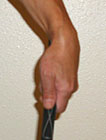
Most golfers use the standard putting grip:

The problem with using this grip is that it mimics the grip of the full swing, and for most players, the full swing is not a thing of deft touch or precise sensation. I have no idea how the subconscious works or what it actually is, but I do know it is something of a simple fool, and if it sees you using a full-swing grip on a putt, chances are your hands will go blind.


(Image courtesy of getintogolf.org)

Here are some other putter grip styles that have come into vogue in the last several years and are helpful at restoring putting sight. They are:


Above: left-hand-low, where you place your left hand below your right. The purported advantage is two-fold: a) it's easier to keep your wrists straight, and b) your shoulders are level.

Then there are the claw grip (and its derivations):


(Images courtesy of dlancgolf.com; polekatgolf.com; pgaprofessional.com.)

I like to call these grips (from left to right): The Dandy, the Bludgeon, and the Glad Hand. They work because they make your brain respond to a putt in a non-full-swing manner--your subconscious thinks, "Hey, this isn't golf. It's... uh... heck, I'm not sure. Let's just hit the dang ball." And PLOP!, you start making puts.

Here's a putting grip that requires its own grip to be installed on your putter:

(wishbonegolf.com)

The creator of this putting system claims it helps with the "yips," a mythical putting ailment that has its basis in neurology.

Lastly, if you're really having a hard time, and mere putting grip changes won't cure your ills, there is the last resort of using a longer putter.

These long putters can be expensive, but if they work for you...?

Remember, 43% of your shots are putts, and they can well determine whether you're going to play to your potential, which is, as we all know and tell ourselves every time we shoot over 90, par--or better.

Wednesday, June 27, 2007

Broom golf sweeping the nation

I don't know where my head's been the last few months, but apparently, there's a new version of golf coming on strong.


I'm not sure how it's played, or what the objective is, but I am sure of one thing: those brooms are awesome! I've looked on eBay for a nice matched set of golf brooms--flighted, frequency matched, the whole deal--but so far all I've found is a custom broom weaving company in Slovenia. I talked with the proprietress, and after a few minutes on the phone, I knew she could hook me up with the sweetest set of brooms. This lady knows her stuff. I faxed her my Ping color code measurements and she said that after three more fittings, she'd send me my new sticks. Her brooms are used all over the world, but her reputation was only solidified after Rudy Takanaga (pictured below)

won the 154th Annual Sweepers Federation Championship. Rudy, you are a true champion! So, I'll be donating my golf clubs to Orange County Flightless Bird Association, and begin my quest for mastery of broom golf. See you on the pitch.

[Images courtesy of: Aga.edu.au; golfhound.com; golf.com; orangecow.org; friedmanarchives.com]

Thursday, June 21, 2007

"How to break 80" is not as simple as it looks

In a previous post I brought to light the theories of Dr. Lucius Riccio on how to break 80. To recap, the theory is: the more greens hit in regulation, the lower your score. Through his Pelzesque statistical analysis of all golfers, he determined that the minimum greens hit required to break 80 is 8. Here is Riccio's greens-hit-to-score chart:


Riccio also admits to the importance of putting. Like GIRs, there are a maximum number of allowable putts to make if 80 is to be broken, thusly:


Lastly, Riccio puts the two charts together to show the maximum number of putts allowable to break 80 if you hit over or under the required number of greens:


So, if you can hit 13 greens, you aren't required to putt any better than your average squirrel. However, if you hit only 4 greens, you'll have to putt better than the best PGA pro.

All these numbers would lead one to believe that approach shots are all important to breaking 80, which is true--if you can't hit the green from 160 yards and closer, you're going to have a long day. But what the numbers are actually saying is that playing very conservatively is what matters. For instance, on a 400 yard hole, what good is a 300 yard drive if it's in the trees without a look at the green? According to Riccio's analysis, you'd be better served to hit a 240 3-wood into the middle of the fairway and take your shot from there. Each hole will require a different conservative plan, which might go as far to play the long par-4s--blasphemy!--as bogey holes, and leave your 8 GIRs to easier holes. This all goes back to Dave Pelz's "Short Game Bible" conclusions, which is that the best scoring players are the best wedgers--at the professional level. What Pelz doesn't consider is that at the amateur level, say, 15 handicap and below, it can't be assumed a player's full-swing shots are going to have the standard 8% accuracy variation. With me and the guys I play with, our tee shots hit the intended target about 50% of the time, which is a serious fly in the Pelz ointment.

Riccio and Pelz are both correct, but what they don't say is just as important for good golf.

Monday, June 18, 2007

A prayer before swinging


From what I've heard, God is huge. He's, like, the biggest thing ever.

Sports, on the other hand, are relatively small. If my team made it to the championship and I had a sick family member at home who needed me, my team would just have to play without me. Which is why I can't understand when athletes pray before participating in their sports events. At the recent U.S. Open (best ever, by the way) the NBC golfcasters noted that before a tee shot, Aaron Baddeley was seen with his eyes closed. I thought he was visualizing a shot, but the commentators said he was praying. What could he have been saying to God? Make me win? Let me play with grace? To not be injured? World peace?

Or do these praying athletes know something that non-prayers don't? Does God answer sports-related queries? With what God has on his to-do list--helping me with my Lotto picks, preventing contrails, keeping the Blimp aloft--I certainly hope he doesn't.

On the other hand, if He is answering, then I'd like to make a request: Would You allow me play as good as I think I am?

Saturday, June 16, 2007

Golf Magazine don't do sexy too well

Athletes can be sexy. But not necessarily. Case in point: Amanda Beard, swimmer--

sexy.

John Daly,

not sexy.

Pro golfers, male and female, have great talent first, and media marketability second. In fact, it's the odd handsome dude or dudette that gets all the attention, hence the media oversaturation of Gulbis.


Ms. Gulbis obviously hopes she can up her stock by showing a little skin. Aesthetic value of the photo aside (just out of the frame, Siegfried is screaming that her rental time is up and that, "I need my stage back to train zee tigers!") she takes her image seriously.

So why do the photos that Golf Magazine included in their June 13 issue "Sexiest Women Golfers" spread look like they were taken by the golfers' spouse/boyfriend/sister/eldest child/goth gal-pal?


None of these women are unattractive, and I'm sure with a professional make-up artist and glamor photog, they could all look perfectly presentable. But really--these are the best the magazine could do?

Tuesday, June 12, 2007

Golf transcendence

The only word that comes to mind when viewing this pic is "immaculate." Is golf a game or a religion?

Sunday, June 10, 2007

My favorite golf score: 8!


Good golf is boring. For instance, the story of a birdie usually goes like this:
"Hit a drive down the right. Wedged it over a bunker to ten feet. Played the putt a cup right, dropped it dying in the hole."

Neat, tidy, and not much of a yarn.

An 8, however, has so much more to tell us. And it doesn't matter on what hole the score was made--par 3, 4, 5--each one will offer up an interesting tale. For instance, my most recent 8, on a par 5, went like this:

Popped my driver just enough to to hit the itty-bitty tip of an overhanging branch just off the tee. Deflected my ball behind and to the right over the twenty-foot high fence guarding the adjacent green. Found my ball near a green-side bunker. Had to hit a low punch which should run at least 100 yards, but instead punched dead-on into the trunk of a pine tree. Back at my feet. Hit the punch again, rolls 75 yards. Slightly hot under the collar, I find my ball on a steep incline, and for some stupid reason, still use my punching 3 iron because now I'm going to teach the ball a lesson. Pop it up another 75 yards. As I walk to the ball, all the while slamming my 3 iron into the soft earth, I picture the ways in which I will crush, eviscerate, dice, obliterate, and nuclearly incinerate my small, defenseless, little white friend. Wanting now only to punish the ball, I take out a 5 wood and, with a very angry swing, pop it up again. 75 yards later, I take out my 7 wood, and despite my anger, hit it just short of the green. Not wanting to cast an angry pall over my playing partners, who have respected my 50 foot bubble of horrible-golf privacy (no one, not even myself, finds it comfortable to play with angry Homer) I joke about how "bizarro" that was. A chip and putt later, all my anger goes poof! Onto the next hole.


See, wasn't that a lot more fun than saying, "Drive, lay-up, pitch, putt, birdie"? Plus, there's something vaguely boring about scratch golfers, as if they've decided to let their clubs do the talking for them, and the only interesting comment they can offer over the 5 1/2 hours of a round are something like, "That's a nice little fade you have there." Another benefit of the 8 was learning that a horrible score doesn't have to ruin the whole round--regrouping is possible!

So if anyone has a great story to tell surrounding a 8 (and I'd really like to hear from someone who earned that on a par 3) please, share!

Thursday, June 07, 2007

e21, anyone?


I found a golf club/shaft company that claims it will--yawn--revolutionize the game. Apparently they have created a "spaced-aged" alloy with qualities like, "25% lighter, 50% stronger than steel..." I knew there was more at work here than just a bunch of metallurgists with too much time on their hands. I checked out the company profile on their website. They have couple of videos of company principals being confident and forward looking as they describe the power of their discovery. But it wasn't until I watched the chief scientist explain the development of scandium, the revolutionary metal in their heads and shafts, that I realized that my suspicions had been justified all along: she was RUSSIAN. This metal was developed for use in MiGs, and SU aircraft. I've seen a MiG, and I don't think it has my best golf interests in mind.

It eased my fears somewhat to learn that a lot of club fitters here in the U.S. offer e21 stuff in their fitting programs. But it still amazes me to know that there are still people out there, even Russians, who are willing to make the claim that golf can be revolutionized. I get that a new putter design can turn a few heads, and not since the introduction of titanium has golf undergone a true revolution. But an alloy? Anyone remember Liquid Metal? Me neither.

But, I have made the public commitment to better my game and if e21 can help me do that (and I'm sure these shafts are ungodly expensive) then they might just play a part in it.

Wednesday, June 06, 2007

Nicklaus thinks Ryder Cup should be worldwide

Finally! Jack Nicklaus has made the argument that the Ryder Cup should be expanded beyond its U.S. vs. Europe scheme. This is a completely fair and long overdue remedy.

The U.S. dominated the matches when they were played against an opposing team comprised of only U.K. players. When the U.K. team was expanded in 1979 to include all of Europe, it was just a few years before the Euros started dominating us.

Ever since that European expansion, the U.S. has struggled, winning only 6 of the 14 Cups (and if you consider the first and second Euro teams as "expansion" teams, then our record is even worse.)

Clearly the balance, and talent, has tipped in the Europeans' favor, and so, as Jack says:

"We keep playing the United States against the rest of the world," said Nicklaus, the captain of the U.S. team in the Presidents Cup, which takes on an international team in September. "Maybe we ought to play East versus West."

"We ought to divide this up a little differently, maybe the Americas (North and South) as a team because it's going to continue to go that way as the game grows internationally," he said. "That's not to say we're not going to have good golfers in the United States, but we're going to have good golfers everywhere else in the world and that's great for the game. I think you're going to continue to see that trend in the game."
(Quote courtesy of golf.com)

It has always confused me that we consider the Ryder Cup the definitive professional match-play event, when many of the world's best players--Els, Sighn, Appleby, and Choi, to name but a few--are excluded.

The other (and unintended) benefit of expanding the Ryder Cup would be it would obviate the need for the President's Cup, which is, let's face it, about as prestigious as two rats fucking in the sewer.

So come on PGA Tour: do something to make the Ryder Cup competitive again.

Sunday, June 03, 2007

Tell me a little about yourself

As I mentioned earlier, I am going to embark upon a journey of personal exploration, by way of golf instruction. During my due diligence into finding an instructor, I found a guy in Texas who prepares his students by telling them to be patient--rebuilding a swing should take around two years. He also doesn't believe a student should see his instructor every week. The student should only take a lesson after he's mastered the previous lesson's instruction, which usually works out to be about a month. So, that means twenty to twenty-five lessons are required to get your game into the shape it deserves to be. Obviously I believe myself to be better than average, and therefore it isn't going to take two years for me to learn a swing. My attitude isn't born of naivety but by super-duper naivety on a level not often seen on planter earth.

However, I am not here to talk about myself, but about you--or rather, for you to talk to yourself. I'm interested to hear any stories you might have about golf lessons, or guitar lessons, yoga instruction, or any kind of learning you've undertaken and how you found that experience to be. For instance: did you have a horrible teacher that made you look for a better teacher? Were you permanently damaged by your first golf instructor, so much so that you never want lessons ever again? I'd love to hear any stories you might have and will post them on der blog.

This week I am going to contact my first prospective instructor and see how it goes. With a little luck, he (or she) will set me on my way to truly understanding the importance of supination.